
|
|
|---|
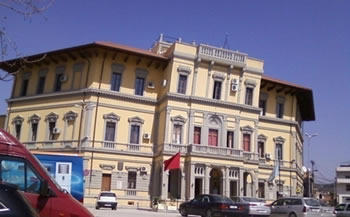 Vlora district has an area of 2706 km ² and a costal border of 244 km. It includes Delvina district (348 km / 2), Saranda (749 km / 2) and the district of Vlora (1609 km / 2). The Centre of Vlora District is located in the city of Vlora. It share borders with the District of Fier in the north, with the district of Gjirokastra in the east, with Greece to the south and with Adriatic and Ionian Sea from the southwest to the west along the coast. Vlora District Population is 374,168 (2010) inhabitants and it has a density of 138.2 banor/km2.
Vlora is anciently known as Aulon. The earliest traces go back to the VI century. BC.
Ali Pasha Tepelena invaded it in 1812. Vlora was the first capital of independent Albania. On November 28, 1912 the National Assembly announced Independence here in Sarajevo Vlorajve and it formed the government under Prime Minister Ismail Kemal Bey Vlora
Saranda is the second largest city in the district of Vlora and it is one of the biggest tourist attractions of the Albanian Riviera. It is only 2 nautical miles from Corfu and nearby there are the remains of the ancient city of Butrint, declared by UNESCO as World Heritage. Delvina is only 16 km northeast of Saranda. There is a medieval castle near the town. At the southwest of Delvina there are the ancient city ruins of Phenicia- today known as Finiqi, which in 2005 was recognized as an Archaeological Park.
Vlora region is populated mostly from the young. Children aged 0-18 years old comprise 25% of the total population of the county (374.168) (General Directorate of Civil Registration in Tirana Interior Ministry 2010).
A novel spirit is felt in the institutions in general as it regard the of children in various state institutions where these problems are dealt with. This shows the awareness of local institutions in terms of recognizing the rights of children. In 2010 the Unit for the Rights of the Child was set up inside the structures of the Council of Vlora district. In 2010, both in Vlora and Saranda Municipality the Child Protection Unit was established. During 2011 the Council set up a monitoring network with 26 representatives in each municipality and commune of the region.
Schools are equipped with IT labs but it should be noted that in most schools they are not functional due to misuse, due to theft of equipment.
Although the percentage of families that benefit from the economic aid and who have children aged 0-18 years old is small at regional level (about 2%), there are a lot of economic problems. Usually families with economic issues live in big cities like Vlora and Saranda.
Roma children are concentrated in Novosela, Susica and Delvina Municipality and a phenomenon that is widespread is the arrival of Roma families from Korca and Elbasan every spring, which start living on the streets of the city of Vlora and Saranda and primarily use their children to beg on the streets. In Vlora region, there are only 3 centers providing services for orphaned children or children who live in extreme poverty or lack one of the parents. These institutions are:
- the baby House in Vlora;
- the Center of developing dishabilles in Vlora municipality
- the child House in Saranda - which serves as a day center.
There is a general awareness by all communes and municipalities of the region to respect the rights of children and the creation of appropriate conditions for children.
Contact person: Jonida Rustemaj
Observatory for Children's Rights Vlora
Sheshi “ 4 Heronjtë” , Këshillli i Qarkut Vlorë , Kati 3-të.
Observatory for Children's Rights is a civil structure set up in Vlora region in 2010, which aim is gathering information from all state and local institutions and study the situation of the implementation of children's rights at the regional level and national levels.
The most important duties of the Observatory are:
Contact person: Zhulieta Kume
Njësia për të drejtat e fëmijëve Vlorë
Këshilli i Qarkut Vlorë , Sheshi “ 4 Heronjtë”
e-Mail: infoturizmi@qakuvlore.gov.al
Prepared by: Jonida Rustemaj,
Expert, Observatory for Children's Rights, Vlorë
 Indicators (district level)
 Indicators (commune level)